What is MRR? How it is calculated?
Published on
•Updated on
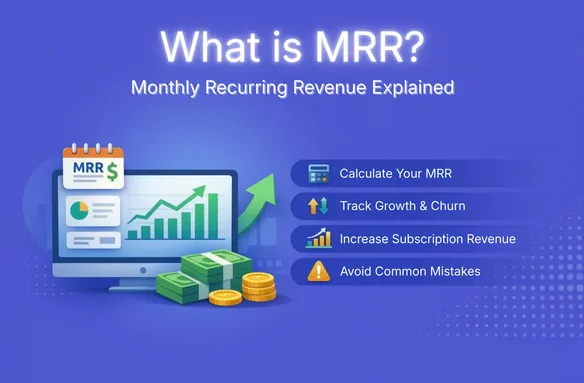
If you run a SaaS or subscription business, revenue rarely arrives as one large payment. Instead, it comes in predictable cycles. That is where Monthly Recurring Revenue (MRR) becomes important.
For subscription companies, MRR is often the single most important metric on the dashboard.
- Investors look at it
- Growth teams track it daily
- Product teams use it to understand the health of pricing and retention
Understanding MRR goes beyond simple arithmetic. It helps founders and finance teams measure predictable income from subscriptions. It also gives a clear indication of product growth and retention.
In this guide, we will explain:
- What MRR is
- Why it matters
- How it is calculated
- How modern SaaS and AI companies can increase it
What is MRR?
MRR (Monthly Recurring Revenue) is the total amount of predictable revenue a company expects to receive every month from active subscriptions.
Simply put:
MRR represents the total subscription income generated from customers in a given month.
In SaaS and subscription businesses, revenue does not always arrive as a single payment. Customers subscribe to plans that renew monthly or annually. MRR represents those payments as a monthly amount.
That is why MRR is widely used as a financial health indicator for SaaS companies.
Example
- A customer paying $100/month adds $100 MRR
- A customer paying $1,200/year contributes $100 MRR
- If 10 customers pay $50/month, your MRR = $500
MRR provides a clear view of a company’s earnings and the true health of its subscription base.
Types of MRR
Not all revenue is created equal. To fully understand MRR, we need to look at the different types used in SaaS analytics.
1. New MRR
Revenue from brand-new customers who subscribe for the first time.
2. Expansion MRR
Additional revenue from existing customers through upgrades or increased usage.
3. Churn MRR
Revenue lost when customers cancel their subscriptions.
4. Contraction MRR
Revenue reduction when customers downgrade their plan.
5. Reactivation MRR
Revenue from previous customers who canceled but returned to a paid plan.
6. Net New MRR
Total monthly revenue growth after accounting for expansions and churn.
Each category helps teams understand how revenue evolves over time.
Importance of Tracking MRR
Understanding what MRR is is the first step. Tracking it consistently is even more important.
Here is why companies closely monitor MRR.
1. Financial Forecasting
MRR provides a stable revenue baseline. Because the revenue is recurring, companies can predict future earnings with high precision.
This allows businesses to plan:
- R&D budgets
- Marketing investments
- Hiring decisions
2. Growth Measurement
MRR shows whether your business is growing or shrinking.
If the number increases every month, your product is gaining traction.
3. Investor Reporting
For startups seeking venture capital, MRR is often the primary metric used for valuation.
It proves that the company has a repeatable revenue model.
4. Operational Efficiency
It helps RevOps teams identify:
- High-value customers
- Potential churn risks
- Revenue contribution by segment
5. Customer Retention Insights
MRR drops when customers cancel. Tracking changes helps identify churn early and understand how much revenue is lost each month.
How to Calculate Monthly Recurring Revenue (MRR)
To calculate MRR, you must first clean your data.
Only include recurring subscription fees.
Exclude:
- One-time setup fees
- Consulting charges
- Hardware sales
These are non-recurring revenue.
Step 1: Identify Active Subscriptions
List all customers currently paying for your product.
Include only active recurring subscriptions.
Do NOT include:
- Setup fees
- One-time services
- Professional consulting charges
Step 2: Convert Plans to Monthly Value
Customers may pay:
- Monthly
- Quarterly
- Annually
Convert every plan into its monthly equivalent.
Example
- $1200 annual plan = $100 MRR
- $300 quarterly plan = $100 MRR
This normalization step is essential for calculating MRR correctly.
Step 3: Apply the MRR Formula
The standard formula:
Example
| Customer | Plan Price | Monthly Value |
|---|---|---|
| Customer A | $100/month | $100 |
| Customer B | $1200/year | $100 |
| Customer C | $50/month | $50 |
Total MRR = $250
Common Mistakes When Calculating MRR
Many teams understand MRR but still calculate it incorrectly.
1. Including One-Time Payments
One-time onboarding or consulting revenue should not be counted in MRR.
MRR measures recurring revenue only.
2. Ignoring Annual Plan Normalization
Annual payments must be divided by 12.
Otherwise MRR numbers become inflated.
3. Counting Inactive Subscriptions
Expired or canceled subscriptions should not be included.
Free trials should also be excluded.
4. Mixing Bookings with MRR
- Bookings = contracts signed
- MRR = active subscription revenue
These are different metrics.
5. Poor Billing Data Structure
If billing systems do not clearly categorize revenue sources, calculating MRR becomes difficult.
6. Ignoring Discounts
If a customer has a $100 plan with a 50% discount, the MRR is $50, not $100.
Best Practices for Calculating and Analyzing MRR
Companies that understand MRR follow disciplined measurement practices.
1. Use Automated Billing Tools
Manual spreadsheets often lead to errors. Use billing systems that track MRR automatically.
2. Track Expansion Revenue
Expansion MRR shows revenue growth from existing customers upgrading or increasing usage.
3. Separate New and Expansion MRR
This helps determine whether growth comes from:
- new customers
- upselling existing customers
4. Track Lost Revenue
Always subtract churned revenue immediately and analyze why customers leave.
5. Track Customer Cohorts
Analyze revenue growth by customer segments or cohorts over time.
6. Understand Gross vs Net MRR
- Gross MRR → excludes churn
- Net MRR → includes churn impact
Net MRR gives a more realistic view of revenue performance.
Five Ways to Increase Your Monthly Recurring Revenue
Understanding MRR is only the first step. The next step is growing it.
1. Improve Customer Retention
Keeping customers longer significantly increases MRR.
Even small improvements in retention can dramatically impact revenue.
2. Offer Expansion Paths
Introduce:
- premium features
- higher tiers
- add-ons
It is easier to sell to existing customers who already trust your product.
3. Optimize Your Pricing Model
Examples:
- Tiered pricing
- Usage-based pricing
- Hybrid subscription models
Even small pricing adjustments can increase MRR.
4. Eliminate Freemium Leaks
If your free tier offers too much value, users may never upgrade. Set clear limits so active users have a reason to move to a paid plan.
5. Adopt Usage-Based or Outcome-Based Billing
Instead of charging per seat, charge based on the value your product delivers. This approach works well for AI agents. When pricing is tied to usage, milestones, or results, revenue can grow as customers get more value.
For deeper context, you can read our guide on ‘What Is Metered Billing?’ and how usage-based pricing works.
RevGate
Want to see how usage-based billing can scale your revenue?
How RevGate Helps Improve Your MRR
Many SaaS companies understand MRR but struggle to optimize it because their billing infrastructure is limited.
Traditional billing systems were designed for simple seat-based subscriptions and fixed monthly cycles.
They often cannot support modern pricing models used by AI products and autonomous agents.
RevGate solves this problem.
RevGate is the revenue growth engine for AI agents and helps companies capture the full value of their product.
With RevGate, companies can:
- Launch flexible usage-based pricing
- Implement outcome-driven monetization
- Track granular revenue attribution
- Experiment with pricing faster
Instead of forcing modern products into rigid subscription models, RevGate supports pricing that matches how AI agents deliver value.
When pricing reflects real usage and outcomes, companies can capture more revenue and support long-term monthly recurring revenue growth.
By tying pricing directly to the value your agents create, you also build stronger customer trust and unlock natural expansion revenue.
RevGate
Ready to grow your MRR?
Want to see how RevGate can improve your revenue model and automate your agentic billing?
Conclusion
Understanding MRR is the first step toward building a sustainable and scalable SaaS business.
MRR is more than just a number on a dashboard.
It reflects:
- how much value you provide to customers
- how predictable your revenue is
- how healthy your subscription business is
By calculating MRR correctly and avoiding common reporting mistakes, companies can forecast growth, improve retention, and make better strategic decisions.
As software evolves from human-operated tools to autonomous AI agents, billing infrastructure must evolve as well.
Do not let legacy systems limit your growth.
Frequently Asked Questions
What is a good MRR rate?
A good MRR depends on the stage of the company. Early-stage startups often focus on consistent monthly growth rather than absolute numbers. While investors usually look for steady growth in monthly recurring revenue combined with strong retention.
Early-stage startups often look for 15% to 20% month-over-month growth. More mature companies generally consider a steady 5% to 7% growth rate to be healthy.